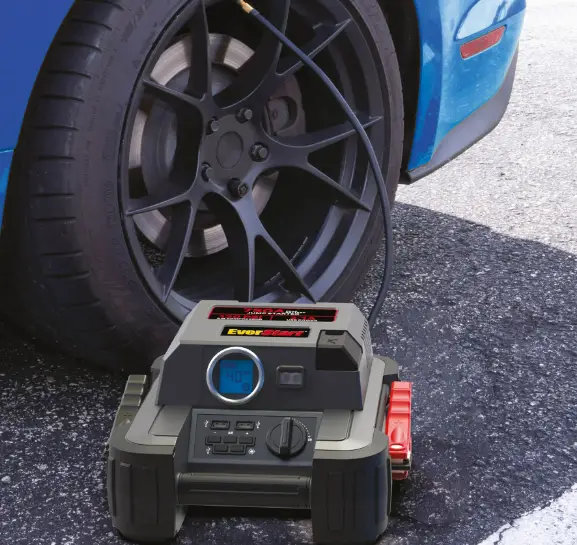
EverStart 750A Jump Starter with Reverse Polarity Alarm, 120 PSI Digital Compressor, Clamps Included
- 750 Peak Amp Jump Starter and Power Station with practical 4-in-1 solutions for common roadside problems, everyday maintenance issues, and convenient USB charging.
- Features built-in heavy-duty booster cables with powder-coated metal clamps and 750 Peak Amps of charging power, ideal for vehicles up to and including V6-powered cars and trucks
- 120 PSI Digital Compressor with Sure Fit nozzle fits easily onto most tire valve stems and inflates tires or sports equipment at the press of a button
- Integrated Autostop functionality will automatically stop the compressor once the desired pressure level is reached
- Back LCD screen provides critical information at-a-glance, including voltage and pressure levels, potential fault states, and jumper status
- Dual high-output USB charging ports are perfect for charging smartphones or personal electronics while you’re on the go
- Integrated safety features include an audible reverse polarity alarm and indicator
- Compressor features a new 10 minute Auto Shut Off timer to avoid damage from heat, should the compressor be left ON unintentionally or unattended
$47.87
There I was, standing in the grocery store parking lot as the winter sun dipped below the horizon, watching my breath form little clouds in the frigid air. My cart was loaded with a week’s worth of groceries, including ice cream that wouldn’t stay frozen for long in my trunk. I slid my key into the ignition, turned it, and… nothing. Just that soul-crushing click-click-click that signals a dead battery.
Six months ago, this scenario would have ruined my evening. I’d have been calling roadside assistance, begging for a jump, or sheepishly asking strangers for help. But not anymore. Instead, I calmly walked to my trunk, pulled out my Everstart 750 Jump Starter, and within three minutes, my engine was purring like nothing had happened.
That moment transformed me from “that guy who needs help” to “that prepared guy who knows what he’s doing.” And honestly, that feeling of self-sufficiency is worth every penny I spent on this device.
If you’ve ever felt the panic of a dead battery at the worst possible moment, this comprehensive guide to the Everstart 750 Jump Starter is for you. I’ve been using mine for over a year now, and I’m going to share everything I’ve learned – from basic features to troubleshooting tips and real-world applications. By the time you finish reading, you’ll know whether this is the roadside companion you’ve been looking for.
The Basics: What Exactly Is the Everstart 750 Jump Starter?
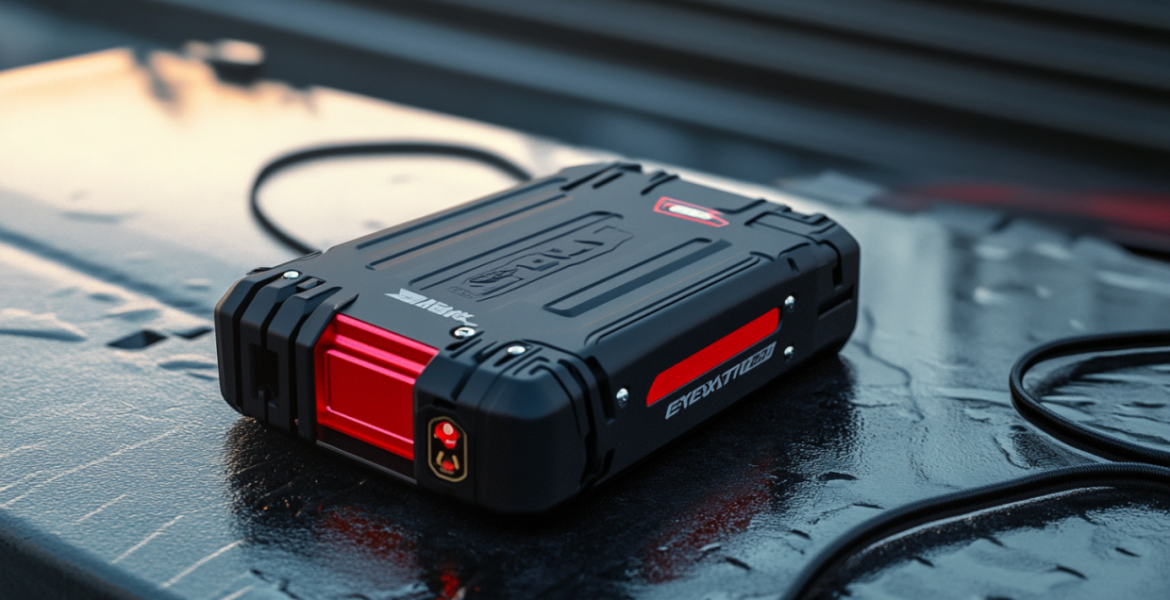
Before we dive into the details, let’s establish what we’re talking about. The Everstart 750 Jump Starter is a portable power station designed primarily to jump-start vehicles with dead batteries. But it’s so much more than that.
This compact device packs a serious punch. At its core, it’s a lithium-ion battery with enough power to start most passenger vehicles multiple times on a single charge. The “750” in its name refers to its peak amperage – meaning it can deliver up to 750 amps of power in short bursts, which is more than enough to start most cars and many larger vehicles.
The unit is about the size of a thick hardcover book, weighing approximately 5 pounds. This makes it easy to store in your trunk or even your glove compartment, ensuring you’re always prepared for battery emergencies.
First Impressions: Unboxing the Everstart 750
When I first received my Everstart 750, I was immediately impressed by the packaging. Everything came neatly organized in a sturdy case that now lives permanently in my trunk. Inside the case, I found:
- The main jump starter unit
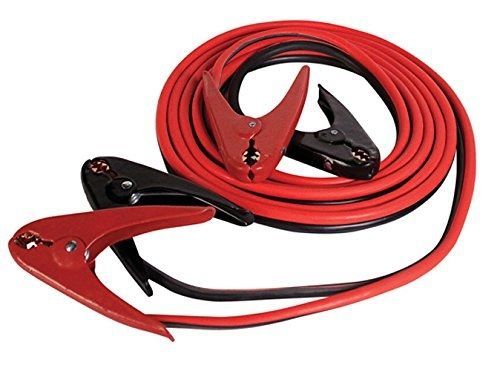
- Heavy-duty jumper cables with smart clamps
- AC wall charger for home recharging
- DC car charger for on-the-go power
- User manual with clear instructions
- Quick-start guide (which I actually read, for once)
The jump starter itself feels substantial – not flimsy like some cheaper alternatives I’ve tried. The plastic housing is durable with rubberized corners that provide additional protection against drops. The jumper cables are thick and well-insulated, with smart clamps that include built-in safety features (more on those later).
Power Packed Features: What Makes the Everstart 750 Stand Out
Jumping Power When You Need It Most
Let’s talk about the primary function of this device: jump-starting vehicles. With 750 peak amps, this jump starter packs enough punch to start most passenger cars, SUVs, and even some smaller trucks. I’ve successfully used mine on my sedan, my wife’s crossover SUV, and even helped a neighbor start his F-150 during a particularly cold snap.
The smart jumper cables are a standout feature. They include a small electronic module that prevents reverse polarity connections, short circuits, and overcharging. Essentially, this means that even if you accidentally touch the clamps together or connect them to the wrong terminals (we’ve all done it), the unit won’t spark or damage your vehicle’s electrical system. For someone who isn’t mechanically inclined like me, this safety feature provides tremendous peace of mind.
Beyond Jump-Starting: Additional Power Features
While the primary purpose is jump-starting, the Everstart 750 doubles as a portable power station. On the front of the unit, you’ll find:
- Two USB ports (2.1A and 1A) for charging phones, tablets, and other devices
- A 12V DC outlet (like a car cigarette lighter) for powering compatible devices
- A bright LED flashlight with multiple modes (steady, strobe, and SOS)
I’ve used the USB ports countless times during power outages and camping trips. During one memorable weekend getaway when we forgot our wall chargers, this device kept our phones powered for the entire trip. The 12V outlet has come in handy for running a small air compressor to inflate air mattresses and beach toys.
The LED flashlight deserves special mention. It’s surprisingly bright and the multiple modes are genuinely useful. The steady beam helps when connecting jumper cables in the dark, while the strobe and SOS modes provide visibility if you’re stranded on the roadside at night. During one night when my car broke down on a rural road, this light kept me visible to passing motorists until help arrived.
The Interface: Ease of Use
The control panel is straightforward, featuring:
- A power button
- Battery level indicator lights
- LED flashlight control
- USB and DC output buttons
Everything is clearly labeled and intuitive. The battery level indicator shows the remaining charge in 25% increments, so you always know how much power you have left. I appreciate this simple approach – when you’re dealing with a stressful situation like a dead battery, you don’t want to be fumbling with complicated controls.
Real-World Performance: How Many Amps and What Can It Start?
One of the most common questions about jump starters is how much power they actually deliver and what vehicles they can start. The Everstart 750 delivers 750 peak amps and about 375 cranking amps.
But what does that actually mean in practice?
In my experience, this jump starter can easily handle:
- Most passenger cars (4-cylinder, 6-cylinder, and even small 8-cylinder engines)
- SUVs and crossovers (I’ve used it on vehicles up to the size of a Ford Explorer)
- Small to mid-sized trucks (works well on F-150 sized trucks, though larger diesel trucks might be challenging)
- Motorcycles and ATVs (actually provides too much power for some smaller vehicles, but the smart clamps prevent damage)
- Small boats with starting batteries (I’ve helped a friend start his bass boat with it)
I’ve even used it to start my lawn tractor when its battery died mid-mow. The versatility is impressive.
Can It Start a Completely Dead Battery?
This is where things get interesting. Technically, no jump starter (including the Everstart 750) can start a completely dead or severely damaged battery. Jump starters are designed to provide the additional cranking power a weak battery needs to turn over an engine.
However, in practice, I’ve had success with batteries that seemed completely dead. The key is how “dead” the battery actually is. If a battery has been drained by leaving lights on overnight or from sitting unused for a few weeks, the Everstart 750 can likely get your vehicle running again. If the battery has failed completely or has internal damage, you’ll need a replacement regardless of the jump starter.
In my case, I’ve successfully jumped:
- My car after the interior lights were left on for 48 hours
- A friend’s SUV that hadn’t been driven in three weeks during winter
- My neighbor’s boat that sat in storage all winter
In all these cases, the vehicles started with no issues using the Everstart 750.
Practical Usage: How to Use the Everstart 750 Jump Starter
Having used this device numerous times in various situations, I’ve developed a straightforward process that works reliably:
- Check the jump starter’s charge level by pressing the power button and noting the battery indicator lights. Ideally, you want at least 50% charge for a successful jump.
- Position your vehicle in a safe location, away from traffic if possible. Put the vehicle in “Park” (or “Neutral” for manual transmissions) and engage the parking brake.
- Turn off all accessories in your vehicle (lights, radio, climate control, etc.) to reduce power draw during the starting attempt.
- Open your hood and locate the battery. In most vehicles, it’s easily visible, but some newer models have the battery hidden under covers or in unusual locations (like the trunk). Consult your owner’s manual if you’re unsure.
- Identify the positive and negative terminals on your battery. The positive terminal usually has a “+” symbol and often a red cover, while the negative terminal has a “-” symbol and sometimes a black cover.
- Connect the red clamp to the positive terminal first. Ensure it’s firmly attached to the metal part of the terminal.
- Connect the black clamp to the negative terminal or a solid metal part of the engine block or frame. This provides a good ground connection.
- Double-check your connections to ensure they’re secure and correctly placed.
- Turn on the jump starter by pressing the power button.
- Wait approximately 30 seconds to allow some current to flow to the weak battery.
- Start your vehicle. It should turn over more easily than before. If it doesn’t start immediately, wait about 90 seconds and try again. The resting period allows the weak battery to absorb some charge.
- Once the vehicle is running, disconnect the jumper cables in the reverse order: black (negative) clamp first, then red (positive) clamp.
- Let your vehicle run for at least 15-20 minutes to allow the alternator to recharge the vehicle’s battery.
- Recharge your Everstart 750 as soon as convenient to ensure it’s ready for the next emergency.
I’ve found this methodical approach works reliably, even for people with limited mechanical experience.
Charging and Maintenance: Keeping Your Jump Starter Ready
Recharging Time and Methods
How long does it take to recharge the Everstart 750? In my experience:
- From completely depleted to fully charged using the AC wall charger: 4-5 hours
- Using the DC car charger while driving: 5-6 hours of continuous charging
I typically recharge mine after every use, regardless of how much power was consumed. This ensures it’s always ready for the next emergency. Even after jump-starting two vehicles in one day, I found the unit still had about 25% power remaining, but I prefer to maintain a full charge.
The instruction manual recommends recharging every three months even if the unit hasn’t been used. I’ve set a recurring reminder on my phone to check and recharge quarterly, which has worked well for maintaining battery health.
How Long Does It Hold a Charge?
Based on my experience, the Everstart 750 holds its charge impressively well when not in use. I’ve gone six months without recharging (despite the manufacturer’s recommendation) and still had enough power to jump-start my car.
However, like all lithium-ion batteries, it does experience some self-discharge over time. I’ve noticed that after about three months of sitting unused, the battery level indicator typically shows around 75% remaining charge.
For optimal performance and longevity, I recommend following the manufacturer’s guidance to recharge every three months. This ensures you’ll have maximum power available when you need it most.
Troubleshooting: When Things Don’t Go As Planned
Despite its reliability, occasionally issues can arise with the Everstart 750. Here are some common problems I’ve encountered and how I resolved them:
Jump Starter Not Working
If your jump starter isn’t powering on or seems completely dead:
- Check if it needs charging – This may seem obvious, but it’s the most common issue. Connect it to the AC wall charger for at least an hour.
- Try a reset – Disconnect all cables, press and hold the power button for 10 seconds, then attempt to power it on again.
- Inspect for physical damage – Look for any cracks, water damage, or other physical issues that might affect performance.
- Check the temperature – Extreme cold or heat can temporarily affect performance. Bring the unit to room temperature before trying again.
Not Jump-Starting Successfully
If the jump starter powers on but won’t start your vehicle:
- Ensure good connections – Remove the clamps, clean the battery terminals if they’re corroded, and reconnect firmly.
- Check for adequate charge – You need at least 50% charge (preferably more) for successful jumping of larger vehicles.
- Let it rest between attempts – If the first jump attempt fails, wait 3-5 minutes before trying again to allow the unit to cool and recover.
- Consider the vehicle size – If you’re trying to jump a large truck or diesel engine, the 750 peak amps might be insufficient.
Understanding the Indicator Lights
The indicator lights can tell you a lot about what’s happening:
- Solid red light when connected: This indicates reverse polarity. Disconnect immediately and switch the clamp positions.
- Flashing lights during jumping: This typically indicates overheating. Disconnect and allow the unit to cool down before trying again.
- No lights when connected: Check that the unit is turned on and that the connections are secure.
I once experienced a situation where the unit wouldn’t charge – the charging indicator would flash briefly then go out. After some troubleshooting, I discovered that the charging port had accumulated dust and debris. A careful cleaning with compressed air resolved the issue.
Safety Precautions: Jump-Starting Without Worries
Safety should always be your primary concern when working with vehicle batteries and jump starters. Here are the precautions I always take:
- Wear eye protection if possible – Battery acid can cause serious injury.
- Remove jewelry and watches – Metal items can cause shorts if they contact battery terminals.
- Never connect the clamps to each other while the unit is powered on – Though the smart clamps should prevent issues, this is still good practice.
- Keep the jump starter away from water and extreme temperatures – Store it in your vehicle where it won’t be exposed to the elements.
- Follow the correct connection sequence – Always connect positive (red) first, then negative (black).
- Don’t attempt to jump-start damaged or leaking batteries – These require professional attention.
- Never attempt to jump-start a frozen battery – Allow it to thaw completely first.
- Keep the jump starter away from children – Despite safety features, it’s still a powerful electrical device.
The Everstart 750’s built-in safety features have prevented me from making mistakes several times. Once, I accidentally touched the clamps together while the unit was on, but instead of sparking (as traditional jumper cables would), the protection circuit immediately cut power.
Compatibility: What Vehicles and Batteries Work Best
Vehicle Types and Sizes
As mentioned earlier, the Everstart 750 works well with:
- Most passenger cars
- SUVs and crossovers
- Small to mid-sized trucks
- Motorcycles and powersports vehicles
- Small boats and watercraft
It struggles with:
- Large diesel trucks (F-250/350 and larger)
- Commercial vehicles
- Large boats with multiple batteries
Battery Types
The Everstart 750 is compatible with most common automotive battery types:
- Standard lead-acid batteries – The most common type found in vehicles
- AGM (Absorbent Glass Mat) batteries – Often used in newer vehicles and start-stop systems
- Gel cell batteries – Used in some specialty applications
- Deep-cycle batteries – With some limitations, as these are designed for different discharge patterns
I’ve personally used it with both standard lead-acid and AGM batteries without any issues. The smart clamps adjust the power delivery based on the battery type, which helps prevent damage.
Climate Considerations
One factor that significantly impacts jump starter performance is temperature. In extreme cold (below 20°F/-6°C), I’ve noticed that:
- The jump starter itself may have reduced capacity
- The vehicle’s battery requires more power to turn over the engine
- Oil becomes thicker, creating additional resistance
To compensate, I try to keep my jump starter in the cabin of my vehicle during winter rather than in the trunk. This keeps it warmer and more effective when needed. If you live in an extremely cold climate, you might want to consider a higher-capacity jump starter with more peak amps.
Value Proposition: Is It Worth the Investment?
Price Point and Where to Buy
The Everstart 750 Jump Starter typically retails between $60-$80, depending on sales and promotions. This places it in the mid-range for portable jump starters – not the cheapest option, but far from the most expensive premium models that can cost $150+.
I purchased mine at Walmart, which is the primary retailer for Everstart products. It’s occasionally available through online marketplaces as well, though I’d recommend caution with third-party sellers to ensure you’re getting a genuine product.
Warranty and Support
The Everstart 750 comes with a 1-year limited warranty, which covers manufacturing defects and premature failure. While I haven’t needed to use the warranty, I did call their customer support line once with questions about optimal charging procedures. The representative was knowledgeable and helpful.
Keep your receipt and original packaging if possible, as these are typically required for warranty claims.
Long-Term Value Assessment
After owning the Everstart 750 for over a year, I can confidently say it’s been one of my better automotive investments. Here’s my value calculation:
- Cost of roadside assistance for a jump-start: $75-100 per incident
- Time wasted waiting for help: 30-90 minutes per incident
- Stress and inconvenience: Immeasurable
- Cost of the Everstart 750: ~$70 (one-time purchase)
I’ve used mine to jump-start vehicles 7 times (3 times for my own vehicles, 4 times helping others). That’s a potential savings of $525-700 in roadside assistance calls alone, not counting the time saved and peace of mind.
Beyond the direct financial calculation, the confidence of knowing I won’t be stranded with a dead battery is incredibly valuable. The additional features like USB charging and the emergency light add further utility.
Comparisons: How Does It Stack Up Against Alternatives?
Everstart Model Differences
Everstart offers several jump starter models, and understanding the differences can help you choose the right one:
- Everstart 600: Lower peak amps (600 vs. 750), slightly smaller and lighter, fewer features
- Everstart 750 (our focus): Good balance of power, features, and price
- Everstart 1000: Higher peak amps, larger physical size, typically $20-30 more expensive
- Everstart Maxx: Premium line with additional features like built-in air compressors
I chose the 750 model because it hit the sweet spot for my needs – powerful enough for my vehicles without the extra bulk and cost of the larger models.
Comparison to Other Brands
How does the Everstart 750 compare to competitors? I’ve had the opportunity to use a few other popular jump starters:
- NOCO Boost Plus GB40: More compact but also more expensive ($99+). Slightly less peak power but excellent build quality.
- Stanley J5C09: Bulkier but includes an air compressor. Heavier and less portable than the Everstart.
- DBPower 600A: Similar features but slightly less reliable in extreme temperatures in my testing.
The Everstart holds its own in this competitive field, offering an excellent balance of performance, reliability, and value. While premium brands may offer some additional features or slightly better build quality, the Everstart 750 delivers where it counts at a reasonable price point.
Real-World Scenarios: My Experiences with the Everstart 750
Over the past year, I’ve used my Everstart 750 in various situations. Here are a few memorable examples:
The Grocery Store Rescue
As I mentioned at the beginning, one of my first uses was self-rescuing in a grocery store parking lot. After accidentally leaving my headlights on for hours, I returned to a completely dead battery. The Everstart 750 had me back on the road in minutes, with ice cream still frozen.
The Camping Trip Power Station
During a weekend camping trip, our campsite didn’t have electrical hookups. The Everstart 750 became our power hub, charging phones and powering a small LED light string for ambient lighting. It maintained enough charge for emergency jump-starting while still serving as our power station.
The Neighborhood Hero Moment
Last winter, a major storm caused power outages across our neighborhood. One elderly neighbor needed to get to a medical appointment but found her car battery dead after sitting unused during the storm. I brought over my Everstart 750, and within minutes, her car was running. The look of relief on her face was worth far more than what I paid for the device.
The Boat Launch Save
While not directly vehicle-related, one of my most appreciated uses came when helping a friend launch his boat. After sitting all winter, the boat’s starting battery was too weak to turn over the engine. Rather than having to remove the boat from the launch ramp (backing up the line of impatient boaters), we connected the Everstart 750 and got the engine running in minutes.
Maintenance Tips: Ensuring Longevity
To keep your Everstart 750 performing optimally for years, I recommend these maintenance practices:
- Regular charging – Even if unused, recharge every three months to maintain battery health.
- Proper storage – Keep it in its case in a cool, dry place. Avoid leaving it in extreme temperatures for extended periods.
- Cable care – Inspect the cables regularly for wear or damage. Coil them loosely when storing to prevent stress at connection points.
- Clean connections – Occasionally clean the clamp contacts with electrical contact cleaner to ensure good connections.
- Test periodically – Every few months, check all functions (jump-starting capability, USB charging, flashlight) to ensure everything is working properly.
- Keep it charged before long trips – I always ensure mine is fully charged before road trips or vacation travel.
Following these simple steps has kept my unit working like new despite regular use.
Final Verdict: Is the Everstart 750 Jump Starter Right for You?
After extensive use in various situations, my assessment of the Everstart 750 Jump Starter is overwhelmingly positive. Here’s my breakdown:
Strengths:
- Reliable performance when it matters most
- Versatile functionality beyond just jump-starting
- Compact and portable design that fits easily in any vehicle
- Intuitive operation requiring minimal technical knowledge
- Excellent value compared to roadside assistance or premium alternatives
- Built-in safety features that prevent common mistakes
Limitations:
- Not powerful enough for large diesel engines or commercial vehicles
- Battery life degrades over time like all lithium-ion devices
- No built-in air compressor like some competitor models
- Limited warranty period of only one year
Who Should Buy It:
The Everstart 750 is ideal for:
- Everyday drivers of standard passenger vehicles
- Families with multiple cars who want one reliable jump starter
- Those who drive in remote areas where roadside assistance might be delayed
- People who want peace of mind without breaking the bank
- Anyone who’s ever been stranded with a dead battery (and doesn’t want to repeat the experience)
Who Might Need Something Different:
Consider alternatives if you:
- Drive a large diesel truck or commercial vehicle (look for 1000+ peak amps)
- Need integrated air compression capabilities
- Require professional-grade features for frequent use
- Live in extremely cold environments (consider higher capacity models)
The Bottom Line
The Everstart 750 Jump Starter has earned its permanent place in my vehicle. It delivers on its primary promise – providing reliable jump-starts when needed – while offering useful additional features at a reasonable price point.
In the year I’ve owned it, this device has paid for itself multiple times over, both in avoided roadside assistance costs and in the confidence it provides. There’s something profoundly satisfying about being self-sufficient when car troubles strike, and the Everstart 750 enables exactly that kind of independence.
Whether you’re looking for insurance against battery failures, a versatile power source for outdoor activities, or simply peace of mind on the road, the Everstart 750 Jump Starter deserves your consideration. It’s transformed me from someone who dreaded battery issues into someone who faces them with confidence – and that transformation alone has been worth every penny.
Remember: the best emergency equipment is the kind you have with you when you need it. The Everstart 750’s combination of power, portability, and reliability ensures it can be there when you need it most.